

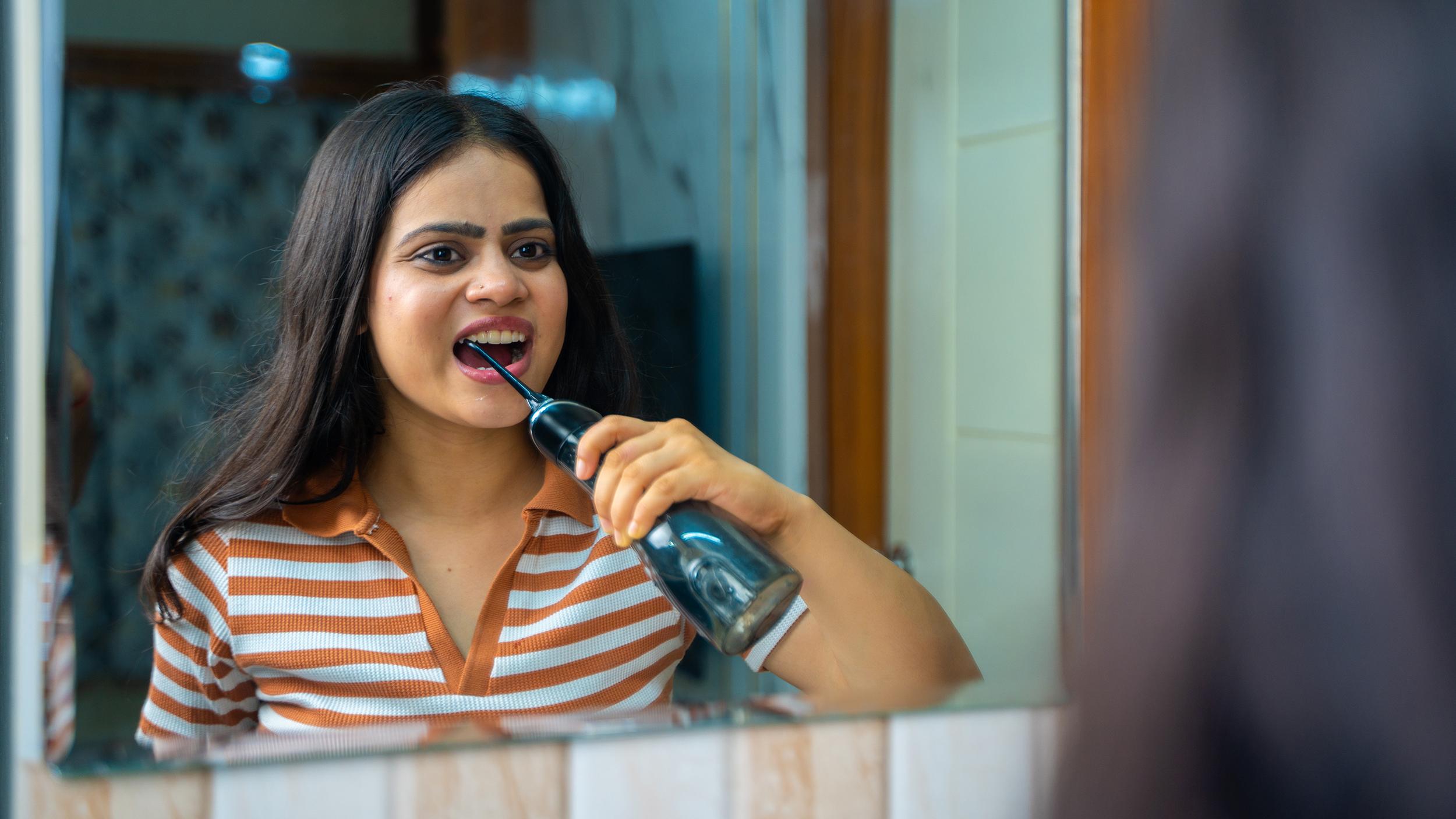
If you’re looking for an alternative to traditional flossing and wondered whether water flossers work, the short answer is that they do. But that leads to more questions – how do they work? Do they remove plaque? Should they be used before or after brushing?
With dental care increasingly going high-tech, it’s good to know that flossing hasn’t been left behind. Because let’s face it – flossing is no one’s favourite activity.
So here’s our expert guide to water flossers with everything you need to know and some recommended water flossers that are worth your attention.
What is a water flosser and how does it work?
A water flosser (sometimes called an oral irrigator) uses a pressurised, pulsating stream of water. This flushes out food debris and disrupt plaque from between your teeth and along the gumline. You fill a small reservoir, select your pressure setting and guide the nozzle tip around your mouth. The whole thing typically takes about a minute.
Most flossers come with adjustable pressure settings. So, if you have sensitive gums you can opt for a lower setting. Then there are multiple nozzle types for different jobs - standard cleaning, braces, implants etc.
Cordless designs like the WATERPIK Cordless Plus WP-492UK are great for travel or storing away in a bathroom cabinet. Countertop models tend to have larger reservoirs for a longer, uninterrupted clean. If you want a deeper look at the options available, our guide to the best water flossers is a good place to start.
Do water flossers actually remove plaque?
Yes, they tackle plaque with something called hydrodynamic cleaning - a combination of water pressure and pulsations. And there’s plenty of independent evidence to support that.
In one trial, a water flosser used alongside toothbrushing reduced whole-mouth plaque by 74.4%, compared with 57.7% for string floss and brushing. Interdental plaque reduction was also significantly higher in the water-flosser group.
The key takeaway: a water flosser isn't a replacement for brushing, but it can be an effective addition to your oral hygiene routine, helping remove plaque from areas that are often missed by brushing alone.

Water flosser vs traditional floss: which is better?
Rather than declaring a winner, it helps to understand what each does well.
| Feature | Water flosser | String floss |
|---|---|---|
| Ease of use | Very easy for most people | Requires proper technique |
| Gum comfort | Gentle on sensitive gums | Can irritate if used incorrectly |
| Braces and dental work | Excellent | More challenging |
| Portability | Depends on the model | Highly portable |
| Ongoing cost | Higher initial cost | Lower cost |
| Food debris removal | Excellent | Good |
| Daily convenience | High | Moderate |
For most people, the honest answer is: use both if you can. But if you’ve always found string floss fiddly or uncomfortable, a water flosser is a genuinely effective alternative that you’re more likely to actually use.
Who benefits most from using a water flosser?
Water flossers are good for most people, but they’re a game-changer for some people in particular:
Brace wearers - getting string floss around brackets and wires is a real faff. A water flosser gets in around the hardware without the struggle.
People with implants, bridges or crowns - the pressurised stream cleans around the base of implants and under bridgework far more effectively than string floss. The PANASONIC Series 800 EW-DJ86-K511 is a solid pick here, with ultrasonic technology and a specialised implant tip.
People with sensitive or inflamed gums – many people find that the gentle pulsating action is far less likely to cause irritation or bleeding than vigorous flossing with string.
Anyone with reduced dexterity – According to the UK's National Rheumatoid Arthritis Society, water flossers are much easier to handle for people with RA.
How do you use a water flosser correctly?
If you’re new to water flossers, here’s a quick step-by-step:
Fill the reservoir with lukewarm water (cold water can be a shock to sensitive teeth).
Start on the lowest pressure setting until you get used to the sensation.
Lean over the sink - it’s splashier than you might expect at first.
Position the tip at a 90-degree angle to your gumline, not pointing straight down.
Work along the gumline from tooth to tooth, pausing briefly between each gap.
Empty any leftover water from the reservoir after each use to keep it hygienic.
For a more detailed walkthrough, our guide on how to use a water flosser covers maintenance too.
Should you add a water flosser to your oral care routine?
If you’re someone who brushes regularly but finds traditional flossing difficult to manage or too easy to forget, a water flosser is worth it. The evidence for their effectiveness is solid, and the ease of use is genuinely better than string floss for most people. Plus flossers like the PHILIPS Sonicare 3000 Series HX3826/33 or the ORDO Hydro Sonic+ make it easy to build into a daily routine.
Water flossers won’t ever replace brushing. And if you can comfortably use string floss, keeping both in your routine is ideal. But for day-to-day gum health and those hard-to-reach spots, a water flosser earns its place on the bathroom shelf.
FAQs
Do water flossers actually work?
Yes. Clinical studies show water flossers are effective at removing food debris and plaque from between teeth and along the gumline, particularly when used consistently alongside regular brushing.
Can a water flosser replace traditional floss?
It can be a highly effective alternative, especially if you struggle with string floss. For the most thorough clean, using both is ideal. But a water flosser alone is significantly better than not flossing at all.
Are water flossers good for braces?
Yes, they’re one of the best options for brace wearers. They can flush debris from around brackets and wires without the difficulty of threading string floss.
Do water flossers help with bleeding gums?
Research shows consistent use can significantly reduce gum bleeding and inflammation. If your gums bleed regularly, start on a low pressure setting and increase gradually.
How often should you use a water flosser?
Once a day is the standard recommendation, ideally before brushing so you don’t blast away the fluoride. Consistency matters more than frequency - a daily minute-long routine is far more beneficial than occasional use.
Can children use water flossers?
Some water flossers are designed for children and may be easier to use than traditional floss. Check the manufacturer's age guidance and always supervise younger children.
Are water flossers safe for implants and crowns?
Water flossers can help clean around implants, crowns and other dental work by flushing away food debris and plaque from hard-to-reach areas. If you have dental work, follow your dentist's advice and the manufacturer's instructions for use.
What should I look for when buying a water flosser?
There are some key things to consider like adjustable pressure settings, reservoir size and cordless vs countertop design. You might also need specialist nozzles for braces tips, implant tips and so on. Our best water flossers guide breaks down the top picks across different budgets.