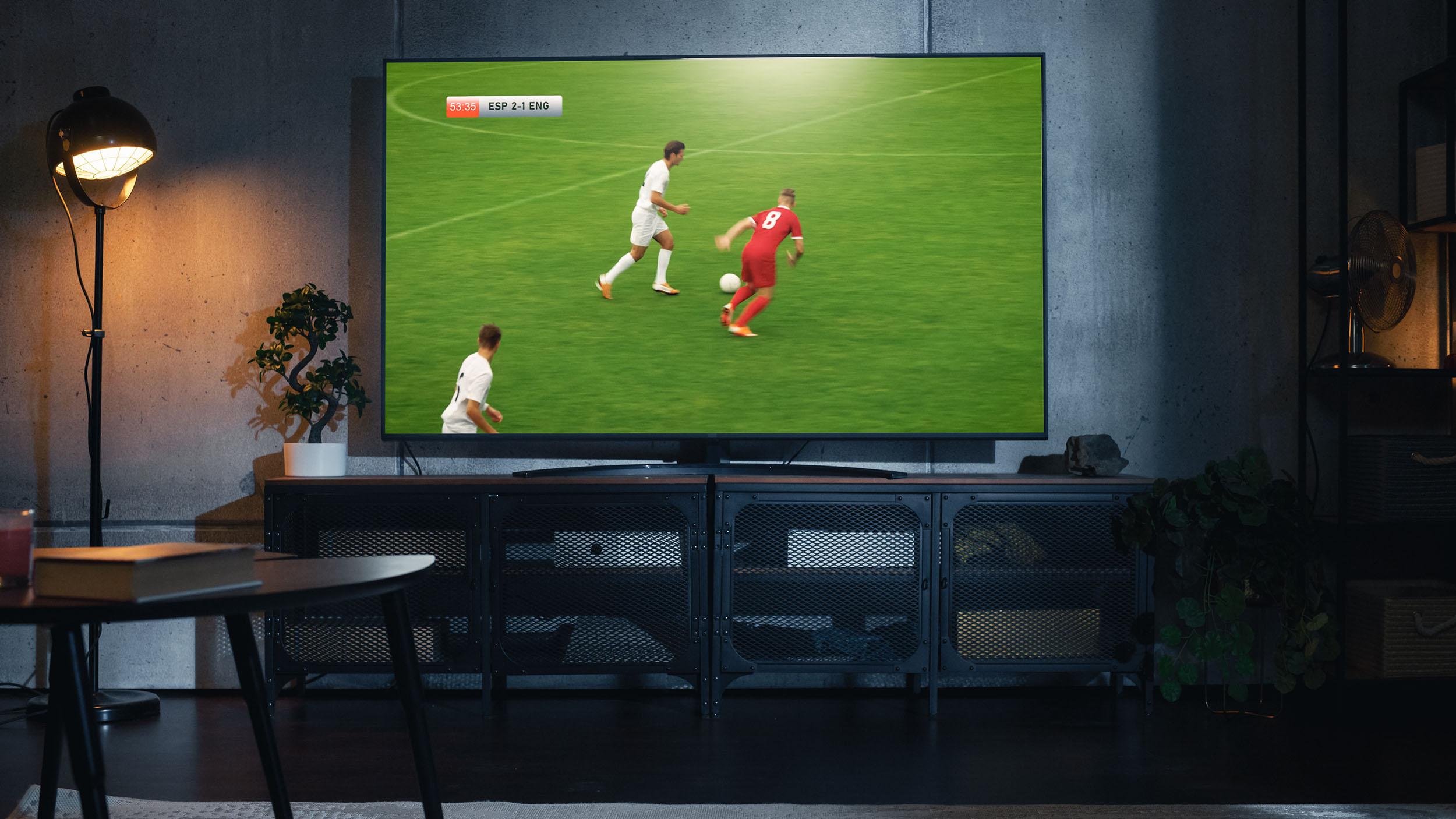



When it comes to the footie, we’d argue that audio is 50% of the experience. You’ve got the roar when a goal flies in. The groan when your team’s defender slips at the worst possible moment. And of course, the outrage when another VAR decision goes against you.
But if you’re watching at home, that atmosphere usually gets lost. That’s because flat and tinny TV speakers don’t do live football any favours. So, if you’ve decided it’s time to switch up your sound, we’re here to help. We’ll tackle all the key points, from complex surround sound to the simplicity of soundbars. Let’s dive in…
What makes football sound immersive at home?
It might sound a tad cheesy, but great sound adds all sorts of feel to the football.
Crowd atmosphere has to be top of our list. There’s the swell of anticipation during an attack. Or the nervous hush before a penalty. That constant sound tells your brain something important is going on. So, when that audio is thin or compressed, you lose all the intensity.
Clear commentary is just as important. You need voices to sit front and centre. On many TVs, commentary competes with crowd noise instead of cutting through it. You turn the volume up and everything gets louder, not clearer.
Bass impact adds weight. Thumping shots and crunching tackles need that sense of physical presence. Without it, matches feel lightweight and lifeless.
Sound separation ties it all together. You should hear commentary clearly, crowd noise filling the room, and on-pitch sounds (like the ref’s whistle) sitting naturally underneath. When everything comes from one tiny speaker, it all mashes together.
This is where TV audio falls down. Most modern tellys are thin, which doesn’t leave a lot of space for punchy, powerful speakers. Luckily, that’s where soundbars and surround sound come in.
What is a soundbar – and why they’re popular for sport
A soundbar is the easiest way to fix poor TV sound. It’s a single, slim speaker that sits under your TV or mounts on the wall. And despite its size, it’s designed to handle all kinds of audio. Dialogue, effects and music all sound way better coming from one of these than the built-in speakers on your telly.
Plug it in, connect it to your TV and you’ll notice a difference immediately. Commentary is now clearer. And the fans at the ground don’t sound like they’re coming from inside a metal tin.
Most use virtual surround sound. This spreads audio wider than the TV and bounces sound off your walls to create a sense of space. It’s not the same as speakers behind you, but it’s a lot more immersive than regular TV audio. Some take this even further, with Dolby Atmos adding extra height and scale to matches.
A lot of soundbars also come with wireless subwoofers. This is a big win for sport. Bass adds energy to the match, with chants and tackles getting more oomph without sounding muddy. Because the sub is wireless, you can place it anywhere that’s convenient too.
Some soundbars will also work with a set of optional rear speakers. That means you’ve got the choice to upgrade your setup later on without committing to a full-on surround system from day one.

What is a surround sound system?
It’s exactly what it sounds like. Instead of using one bar, you’ll place multiple speakers around your room. Typically, that means front speakers, rear speakers and a subwoofer. Some setups even add height speakers too.
This creates proper surround sound. Crowd noise really does come from around you. While stadium ambience, ahem, surrounds the sofa. When it’s done right, it’s seriously impressive.
There are two main types. Wired systems with an AV receiver are going to give you the most flexibility and control. You can tweak audio settings, add more speakers – if you really need them – and fine-tune levels. The trade-off is that they’re complex to set up. Not to mention all those wires!
Wireless surround systems come with a bit less clutter. They still need to be positioned carefully though, with somewhere to plug them in. They’re definitely easier to get up and running than wired systems but aren’t quite plug-and-play.
Setup takes time. You need space for speakers. There’s got to be room to run cables, or place wireless units. And then there’s the patience to configure it all properly.
Is it better than a soundbar? If you’ve got the right room (and really care about audio), then yes. But it also asks a lot more from you when it comes to setting everything up.
Surround sound vs soundbar – key differences for football fans
For live football, you’ve got plenty of technical and practical differences to think about…
Immersion: Surround sound definitely gives you the biggest stadium feel. Especially in larger rooms. A soundbar will still create a wide, punchy soundstage though – just without speakers behind you.
Dialogue clarity: We’ll give soundbars the win here. They’re tuned to push voices forward. And lots come with special dialogue modes that put voices front and centre, which is perfect for commentary. Surround systems can sound great. But they need careful calibration to stop voices getting lost.
Setup: Soundbars are easy to set up. Plug in a cable or two and you’re ready. Surround sound takes a lot more time to get up and running. Oh, and a lot of patience if you want things sounding perfect.
Space and cables: One neat bar or multiple speakers and wires? This matters in normal living rooms, where there’s limited space. And you probably don’t fancy cluttering up the place, right?
Cost vs benefit: Surround systems cost more. Especially when you factor in the installation and any upgrades. For most fans, the extra immersion just doesn’t justify all that effort.

Matchday reality check – what most football fans actually need
Let’s be honest, most football is watched in regular living rooms. Not purpose-built cinema rooms that cost thousands of quid to put together. So, when it comes to sound, most fans just want:
Clear commentary – Whether they’re discussing the lineup or a controversial VAR decision.
Big crowd noise – They say football is nothing without fans. And it’s true. There’s not much like hearing that wall of noise when your team scores the winner.
Easy volume control – You don’t want to spend another 90 minutes lost in a settings menu. A controller with a few simple buttons is always the best bet for your average punter.
A versatile setup – Once the game’s over, you’ll probably flick over to something else. And you’ll want shows and films to sound just as good as Arsenal throwing away another league title.
When surround sound is worth it for football
Surround sound only really makes sense if:
You have a large lounge – you’ll need space for all of those extra speakers.
You’ve built (or are building) a dedicated cinema room, where audio is just as important as the picture.
You regularly host big matchday gatherings – you don’t want anyone to miss an iconic line of commentary (Peter Drury, we’re looking at you).
You genuinely enjoy tweaking and calibrating audio. You’ll have lots of options to play around with.
In these cases, surround sound can be epic. That full wrap-around crowd noise really makes matches more immersive. And you’ll feel like you’re sat pitch side cheering on your team. Just be honest with yourself about how often you’ll actually use it. After all, the cost of a full surround setup can rack up quickly!

When a soundbar is the smarter choice
For most footie fans, a soundbar is the perfect sweet spot.
They’re incredibly easy to set up. You’ll only have to plug in one or two wires. Then hit the on button, and you’re good to go.
There’s minimal clutter. Less wires and speakers mean less mess!
You have big, room-filling sound from the off. There’s no calibrating levels or finding the sweet spot for rear speakers here.
Excellent dialogue clarity – When the commentators yell GOAAAAALLLL! after a 30 yard screamer, you’ll hear it loud and clear.
If you want better sound right now – and don’t fancy fiddling with wires and speakers all weekend – a soundbar is the clear winner. Plus, they’re better value for money if football is only a small part of what you like to watch.
A simple buyer’s shortcut – soundbar or surround sound
Not sure what to go for? Our cheat sheet below should help you to decide.
| Scenario | Solution |
|---|---|
| If you want better sound without a complicated setup | Soundbar |
| If you watch football in a normal sized living room | Soundbar |
| If you care about the commentary | Soundbar (with dialogue enhancement mode) |
| If you want a big upgrade from TV speakers | Soundbar with subwoofer |
| If you host casual match day watch parties | Soundbar with subwoofer |
| If you want the most immersive stadium style atmosphere possible | Surround sound |
| If you have a large room or dedicated media space | Surround sound |
| If you like tweaking and customising audio | Surround sound |
| If you want minimal cables and clutter | Soundbar |
| If football is part of a full home cinema setup | Surround sound |
FAQs
Is a soundbar good enough for watching football?
Definitely. A decent soundbar will give you clearer commentary, along with bigger crowd noise for all of those nail-biting moments.
Does surround sound make football more immersive?
It can. In the right room, surround sound creates a more realistic, stadium-style atmosphere. You’ll get the most out of it – and notice a real difference – in larger rooms.
What’s better for commentary clarity: soundbar or surround sound?
Soundbars often perform better straight out of the box. That’s because they’re tuned to push voices forward towards your spot on the sofa. It’ll feel like the commentary team are sat right next to you!
Do you need Dolby Atmos for live sport?
No. Atmos is a nice bonus but isn’t a must-have. It’ll add more scale to your audio, but the footie will still sound great without it.
Can a soundbar replace a surround sound system?
For watching the game, yes. For full, cinema-level immersion, not quite. Most fans won’t miss the difference though. Not unless you’re a serious audio aficionado.
Is surround sound worth it in a small living room?
In our opinion, usually not. Placing your speakers properly gets a lot harder with that lack of room. And the difference you’ll actually notice over a soundbar is going to be limited.
What audio setup is best for matchday watch parties?
You can’t go wrong with a soundbar and a subwoofer. It’ll make matches sound loud and clear. And everyone can hear what’s going on wherever they’re sitting.
Is it better to upgrade TV sound or picture first?
That really depends on what’s more important to you. You’ll notice poor audio faster than a slightly weaker picture quality, especially during live sport.

Need more advice?
We’ve got loads more tips on how to make your footie viewing even better. Check out the best TV settings for football to get your telly ready for this summer’s tournament. And is bigger better? See what we think and have a read of is a bigger TV better for watching football and movies? Spoiler – yes, they are!