

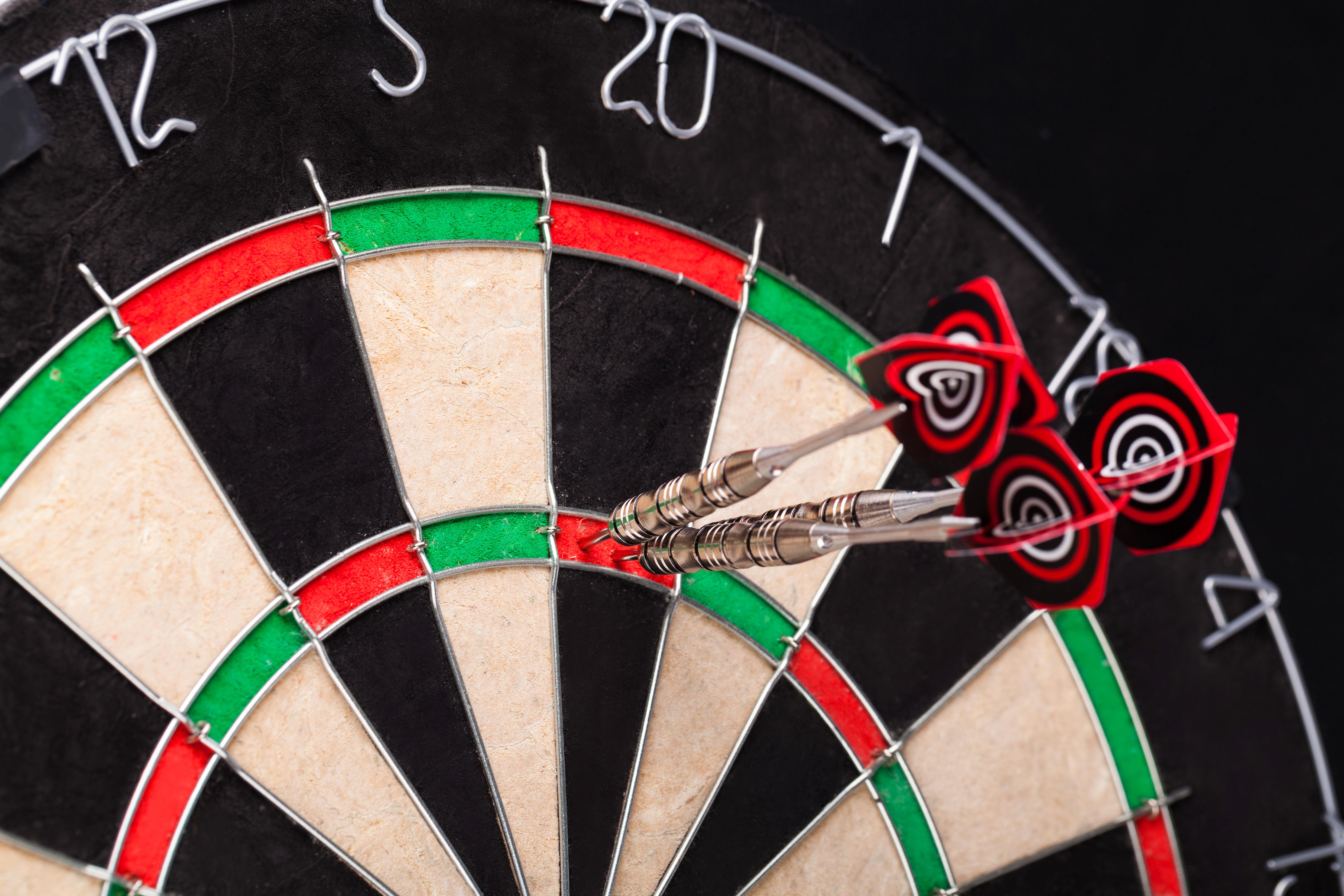
Fancy yourself as the next Luke Littler or Fallon Sherrock? Darts is a brilliant game to get into. It’s easy to pick up, great fun with friends and family, and you don't need loads of room to play. You can’t beat the feeling of hitting a bullseye - even if you were aiming for a double one at the time.
Before you pick up your arrows, it’s worth getting your dartboard measurements right. Measure from the wrong place or hang it too high, and you could be throwing yourself off before you’ve begun.
In this setup guide, we’ll cover the official dartboard height and distance for steel-tip darts, how soft-tip measurements differ, and how to hang and measure your board. We’ll also look at cabinets, wall protection, lighting, wheelchair-friendly options and smart scoring systems.
Oh, and we also got some great advice from the founder of Darting HQ, Kev Foulds. You’ll see his expert tips now and again!
Regulation dartboard height and distance

It’s best to put your dartboard at the regulation height and throw from the official distance. That means when you step up to a board in a pub, club or competition, you won't have to adjust your throwing position. Here are the correct measurements:
| Measurement | Official distance |
|---|---|
| Floor to centre of bullseye | 173cm (5ft 8in) |
| Face of board to throwing line | 237cm (7ft 9¼in) |
| Diagonal from bullseye to throwing line | 293cm (9ft 7½in) |
Dartboard height. The centre of the bullseye should be 173cm from the floor. Measure to the middle of the bullseye, rather than the top or bottom of the board.
Throwing distance. Stand 237cm back from the face of the dartboard. This is measured horizontally from the front of the board to the back edge of the throwing line (also called the oche). Don't measure from the wall.
Diagonal measurement. There's another way to check your measurements. The diagonal distance from the centre of the bullseye to the back edge of the oche should be 293cm. It's a useful final check that your board is positioned correctly.
Kev's expert tip. The one number that matters most is 173cm, the official height from the floor to the centre of the bullseye. Mark that point on the wall first and hang the board around it, rather than guessing from the wall bracket.
How to measure your dartboard throwing distance
When your dartboard is at the right height, it's time to mark out where you'll stand.
Measure 237cm out from the face of the dartboard.
Mark the floor where the back edge of the throwing line will sit. You can use a dedicated oche or a simple strip of tape.
Check the diagonal measurement from the bullseye to the oche is 293cm.
Make sure the throwing line is clearly marked so you know where to stand.
Kev's expert tip: Always measure from the face of the board. If you measure from the wall, the thickness of the board and its mounting can throw your distance out.
How to hang a dartboard
When you’re ready to hang a new dartboard, choose a suitable wall with enough room for the throwing distance and space to move around safely. You’ll want a solid surface that can support the weight of the board and its mounting.
Here are a few simple steps for fitting a dartboard properly:
Mark the position. Use the official dartboard measurements to mark where the centre of the bullseye needs to sit.
Fit the mounting bracket. Attach the bracket or fixing plate to the wall using suitable fixings for your type of wall.
Hang the board. Secure the board onto its mounting, making sure it's firmly attached and doesn't wobble.
Check that it’s level. Make any necessary adjustments so the board hangs straight.
Make sure you’ve got it right. Double-check the measurements to make sure everything meets regulation standards.
Kev's expert tip: Use the diagonal measurement as your final check. It's a handy way to confirm the board height and throwing distance are both correct.
If you're choosing a new board, Target dartboards are worth considering. Their range includes features designed for regular play and easier setup, such as slim stainless-steel wiring, rotating number rings and adjustable levelling systems

The Target TOR dartboard is a competition-standard board with slim stainless-steel wiring to help reduce bounce-outs. Its clever Peak-Fix lock and level system has three adjustable feet at the back, so the board always sits securely and level – even on uneven walls.
The Target Rift dartboard set comes with two sets of 17g brass darts, and a wall mounting kit to help you get the board securely attached and ready for play. The board also has a rotating number ring to spread wear, and a staple-free bullseye to help reduce bounce-outs.
Steel-tip vs soft-tip dartboards

If you're playing with soft-tip darts and an electronic dartboard, the throwing distance is slightly different to traditional steel-tip dartboards:
| Measurement | Steel-tip darts | Soft-tip darts |
|---|---|---|
| Bullseye height | 173cm | 173cm |
| Throwing distance | 237cm | 244cm |
Soft-tip players stand 244cm from the face of the board, giving them an extra 7cm of throwing distance. Always check the manufacturer's instructions, too, as electronic boards can have their own installation requirements.
The main difference is the equipment. Steel-tip darts have sharp metal points and are designed for traditional bristle boards, usually made from sisal. Soft-tip darts have flexible plastic points and are designed for electronic boards with small holes in their playing surface.
Electronic dartboards are a popular choice for families and beginners because they often include automatic scoring, different games and sound effects. The Toyrific electronic dartboard for example, offers 28 games and 159 modes, along with plastic replacement tips. It's a child-friendly, non-regulation option rather than a board for competitive play.
Wheelchair-friendly dartboard measurements
Darts can be enjoyed by players with different mobility needs – although the standard playing height might not work for everyone.
For wheelchair users, the recognised alternative bullseye height is 137cm from the floor. The throwing distance should be measured from the front of the board, with the playing position allowing enough room for the wheelchair.
The lower height lets wheelchair users play from a more comfortable position, while keeping the standard throwing distance. If you're setting up a board at home, an adjustable wall bracket or mounting system can make it easier to switch between standard and wheelchair heights. Just make sure the board is securely fixed, and that there's enough clear space around the wheelchair to move and throw comfortably.
Dartboard cabinets and wall protection
Darts don't always go where you mean them to. A stray throw or bounce-out can leave a mark or two (or a few hundred) on your wall, so it's worth thinking about protection before you start playing. You’ve got two main options:
Dartboard cabinets. These fit around the board and usually have doors that close when you're finished. They're a neat all-in-one solution that can also include scoreboards.
Dartboard surrounds. These fit around the outside of the board, providing a protective area to catch stray darts. They're generally lighter and more open than cabinets.
The Target Summit dartboard & cabinet set is a useful all-in-one option. It includes a self-healing board, two sets of darts, and a cabinet that keeps everything looking tidy between games.

If you'd prefer something more open, the Target Corona Vision LED notched dartboards surround combines wall protection with blue LED lighting. It's compatible with regulation-sized dartboards, with the board sold separately.
One important measurement tip: fit your cabinet or surround before measuring and marking the oche, as a cabinet can position the board further out from the wall.
Dartboard lighting
Good lighting makes it easier to see the numbers, segments and trebles clearly. It also helps reduce shadows across the board, so you're not trying to judge your next throw in poor light.
Dedicated dartboard lighting systems are designed to illuminate the board evenly, often using LED lights mounted around its circumference. Some attach directly to the board, while others use their own mounting system.
The Target Corona Vision 2 dartboard lighting system is designed to illuminate the playing surface, helping you see the scoring areas clearly and reducing shadows across the board. It's a great option if you’re putting together a games room or improving the lighting in a garage.
Kev's expert tip: Watch out for shadows when positioning your lights. You want the whole board evenly illuminated, without casting shadows across the scoring areas.
Smart dartboards and electronic scoring
If you like keeping track of your scores, a smart dartboard or electronic scoring system can take some of the mental arithmetic out of the game.
Electronic soft-tip boards automatically register where your darts land and calculate your score. Some also offer different games and multiplayer mode. You can also find smart scoring systems that use cameras to track your darts on a traditional steel-tip board. These can display scores on a connected phone, tablet or screen, so you can concentrate on your throwing. Here are a couple of options worth looking at:
The Target Omni smart dartboard auto-scoring system uses four HD cameras to track dart positions and automatically calculate scores. It also includes LED ring lighting and works with the DartCounter app, so you can play online and keep track of your performance.
The Scolia Home 2 Flex smart dartboard auto-scoring system uses optical camera sensors and the Scolia app to record scores, stats and game history. It also supports online multiplayer, with up to 1,000 throws a month available without a subscription.
Both systems are designed for steel-tip darts and need to be installed around a compatible regulation board. Check the mounting requirements and available space before you invest in one.
You'll also need a decent set of darts. There are plenty of different weights, barrel shapes and grip styles available, so it's worth trying a few to see what feels comfortable in your hand.
Kev’s expert tip: Don't buy one set and stick with it. Start by trying darts of different weights and find the ones that suit you. The thickness of the barrel really matters. A slim barrel and a chunkier one feel completely different in the hand, and that can make all the difference to your throw.
Looking after your dartboard
A little maintenance can help your dartboard last longer and keep playing well.
Rotate the board. Traditional sisal dartboards can be rotated periodically to spread wear across the scoring segments. Avoid rotating the number ring independently of the board's instructions.
Look after the surface. Keep the board in a dry environment and avoid getting it wet.
Check the mounting. Make sure the board remains securely attached to the wall.
Look after your darts. Check the points, flights and shafts regularly, replacing damaged parts when needed.
Need more help?
Ready to take aim at creating your darts setup? Browse our range of darts equipment, dart sets and darts accessories to find all you need to up your game. Or pop in-store and chat to one of our expert colleagues - they'll help you find the perfect checkout kit.
FAQs
How high should a dartboard be?
The centre of a regulation dartboard bullseye should be 173cm (5ft 8in) from the floor. This is the official height for both steel-tip and soft-tip dartboards. Measure from the floor to the centre of the bullseye, rather than the top or bottom of the board.
How far back should you stand when playing darts?
For steel-tip darts, the throwing line should be 237cm (7ft 9¼in) from the face of the board. For soft-tip darts, it's 244cm (8ft). Measure from the front of the board, not the wall, to the back edge of the throwing line.
What is the diagonal dartboard measurement?
For a regulation steel-tip dartboard, the diagonal distance from the centre of the bullseye to the back edge of the throwing line should be 293cm (9ft 7½in). This is a handy way of double-checking that your board height and throwing distance are correct.
What is the throwing line in darts called?
The throwing line is commonly called the oche (pronounced 'ockey'). It's the line players must stand behind when throwing. For steel-tip darts, it's positioned 237cm from the face of the board.
~
Thanks again to Kev Doyle for his expert advice and help in compiling this guide. Kev is the founder and editor of Darting HQ, an independent UK darts site covering game rules, player profiles, the PDC tournament calendar and dartboard setup. You can also find Kev on Facebook, Pinterest and X.