

If you’re kitting out your home gym, you’ll probably have come across cross trainers and ellipticals. So, what’s the difference?
Here’s the short answer: in the UK, we tend to use cross trainer and elliptical to describe the same machine. Both give you a low-impact cardio workout where your feet move in an oval motion. However, some people use cross trainer to refer specifically to models with moving handlebars that work your upper body too. While elliptical can sometimes refer to machines that focus mainly on the lower body.
Confused? Don’t sweat it. We’ll break down exactly how they work, where the differences come from, and which type is right for you.
What is a cross trainer?
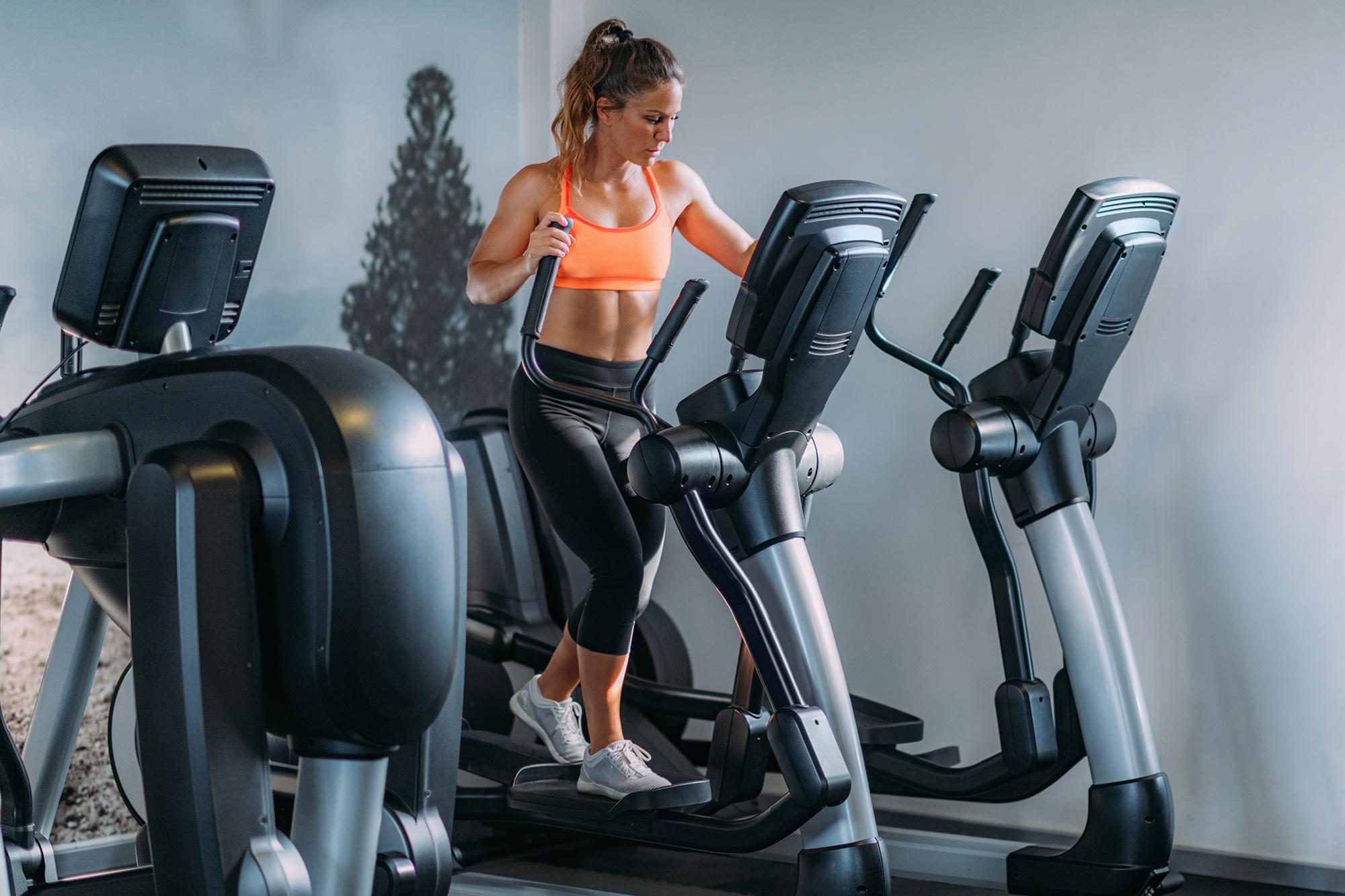
A cross trainer is a cardio machine that’s designed to mimic movements like walking, jogging, climbing stairs and skiing – all without the impact that usually comes with them.
Your feet stay on large pedals while they move in a smooth elliptical (oval) path. Most also have moving handlebars that work in sync with your legs, letting you exercise your arms, shoulders, chest and back at the same time.
A standard cross trainer includes:
Large foot pedals.
Moving handlebars.
A flywheel that creates momentum.
Adjustable resistance levels.
Workout programmes and fitness tracking features.
Because your feet never leave the pedals, cross trainers are considered a fairly joint-friendly option. This makes them a great shout for anyone looking for an effective cardio workout without the impact of something like running.
What is an elliptical?
An elliptical is essentially the same type of machine. In fact, elliptical is the more common term in the USA, while cross trainer is generally preferred here in the UK. The name comes from the shape of the pedal movement, which follows an elliptical or oval path.
There are a few different kinds of ellipticals, including…
Front-drive ellipticals with the flywheel positioned at the front.
Rear-drive ellipticals where the flywheel is at the back.
Recumbent ellipticals that combine a seated position with elliptical movement.
Elliptical-stepper hybrids which mix climbing and striding motions.
Some ellipticals use moving handlebars, while others have fixed handles and focus more on lower-body training.

Cross trainer vs elliptical: key differences
For most people, the differences are quite small. That’s because the two terms are used interchangeably. That said, when people distinguish between the two, they’re usually referring to the handlebars and workout style. You can see how the pair stack up in the table below…
| Feature | Cross trainer | Elliptical |
|---|---|---|
| Pedal movement | Elliptical motion | Elliptical motion |
| Handlebars | Usually moving | May be moving or fixed |
| Upper-body workout | Yes | Sometimes |
| Lower-body workout | Yes | Yes |
| Impact on joints | Low | Low |
| Footprint | Typically 59-79 inches | Typically 70-80 inches |
| Best for | Full body cardio | Versatile, low-impact exercise |
Tech tip: The important thing to remember is that there’s not really a strict industry definition. One manufacturer’s elliptical might look almost identical to another brand’s cross trainer.
Which is best for your home gym?
The best choice depends on how you plan to use it.
Choose a cross trainer if:
You want a full body workout.
You like using your arms and legs together.
You enjoy interval training and higher-intensity sessions.
You want to work on multiple muscle groups at once.
You’re replacing outdoor running with a lower impact alternative.
Choose an elliptical if:
You mainly want to do lower body cardio.
You prefer the extra stability of fixed handlebars.
You’re looking for a machine with smooth, comfortable movement.
You’re thinking about a speciality style (like a recumbent elliptical).
You want a gentle option for regular exercise.
At the end of the day, either machine is going to give you pretty similar benefits. The right decision often comes down to specific features and how comfortable you feel on one. Oh, and make sure you have enough space too!
What to look for in a cross trainer
Not every cross trainer comes with the same set of features. Here are some key ones to look for before you buy…
Adjustable incline – Some models let you adjust the incline of the pedal path. Raising it will add variety to your workouts and make muscles like the glutes and hamstrings work harder.
Built-in programmes and apps – Certain cross trainers come with pre-set workouts for intervals, endurance sessions and hill climbs. And others are compatible with popular paid apps (like iFit AND New Image Fitness).
Quiet operation – Machines with magnetic resistance and belt-drive systems tend to run more quietly than older friction-based models. Putting a workout mat underneath can also help to lower vibration and protect your floor.
Compact construction – Folding cross trainers are pretty rare. If you’ve got limited space, look for compact designs with wheels. Then you can roll it into a corner when you’re done using it.
Stride length – A longer stride tends to feel more natural for taller people. Shorter strides work well in compact machines but might not be as comfy during longer sessions.
Resistance levels – Lots of resistance levels gives you more room to progress. It’ll help to keep your workouts challenging as your fitness gets better too.
Flywheel weight – The heavier the flywheel, the smoother the feel is while you exercise. They’ll also make any transitions between speeds and resistance levels feel a lot more natural.
Maximum user weight – Always check the manufacturer’s recommended user weight. Then you’ll be able to make sure the machine is suitable for anyone who plans to use it.

Best cross trainer for home
Model: Proform Carbon EL Smart Bluetooth Elliptical Machine
Why we love it: AI is everywhere at the moment. And now it’s in your cross trainer! Your AI coach can schedule in daily sessions and create custom workout plans that suit how you like to exercise. And if things are too hard – or too easy – it’ll dynamically adjust the routines to match your current level of fitness.
FAQs
What muscles does a cross trainer work?
A cross trainer works both the upper and lower body. The pedals target muscles like the glutes, quads, hamstrings and calves, while moving handlebars engage the chest, back shoulders and arms. This makes it one of the few cardio machines that involves a big part of your body’s major muscle groups.
What is the difference between front-drive and rear-drive ellipticals?
The main difference comes down to the position of the flywheel. Front-drive models put it near the front of the machine (which gives them a more compact footprint). Rear-drive machines have one at the back, which adds a slightly smoother, more natural feel to each stride.
How long should you use a cross trainer for?
If you’re a beginner, anything from 15 to 20 minutes is a good starting point. As your fitness improves, you can then gradually build up the length of your sessions.
How do you maintain a cross trainer?
To keep your cross trainer in good nick, wipe down any sweaty surfaces after your workout. Then, in the long term, check that any bolts are still secure, and look at each moving part for signs of wear. The manufacturer will also have more guidance on things like lubrication and servicing. A little bit of regular maintenance will help to keep your machine running smoothly for longer.
How much space do you need for a cross trainer vs an elliptical?
Most cross trainers and ellipticals need a space of roughly 120 cm to 200 cm long and 60 cm to 90 cm wide. You’ll also need enough ceiling height for your body and the pedal movement. Leave some extra room around the machine so it’s easy (and safe) to get on and off too.
Need more advice?
We’ve got loads of other tips and tricks when it comes to picking out some new gym and exercise equipment. Want to know more about the best adjustable dumbbells for home use? You don’t have to weight around to find out. And if you want to learn which are the best treadmills and walking pads for home in 2027, get up and running with this handy guide.