

As summer approaches, the great British holiday exodus is underway. However, before packing your favourite hair and beauty tech, you’ll need to check whether it’s electrically compatible with your destination.
Global electrical standards vary by plug type, voltage, and frequency, meaning you may need to pack some extra equipment to avoid a dead hair dryer or a fried straightener ruining your holiday glow. While many top destinations are compatible with UK devices (particularly those using 220-240V power supplies), success depends entirely on your location and device. Dual-voltage items, like phone and laptop chargers, only require a standard plug adapter, while single-voltage, high-wattage beauty tools require a voltage converter to operate safely in countries with different voltages.
To help you prepare, our research team analysed the most popular travel destinations for Brits to identify which countries you need to be aware of when plugging in your appliances. Our handy guide breaks down all the equipment you’ll need to help you avoid your Dyson hair dryer not working abroad and ensure all blow-outs go as planned. Plus, check out our team’s expert comments for travel-sized tips and tricks!

Countries Where UK Electronics Need Extra Care
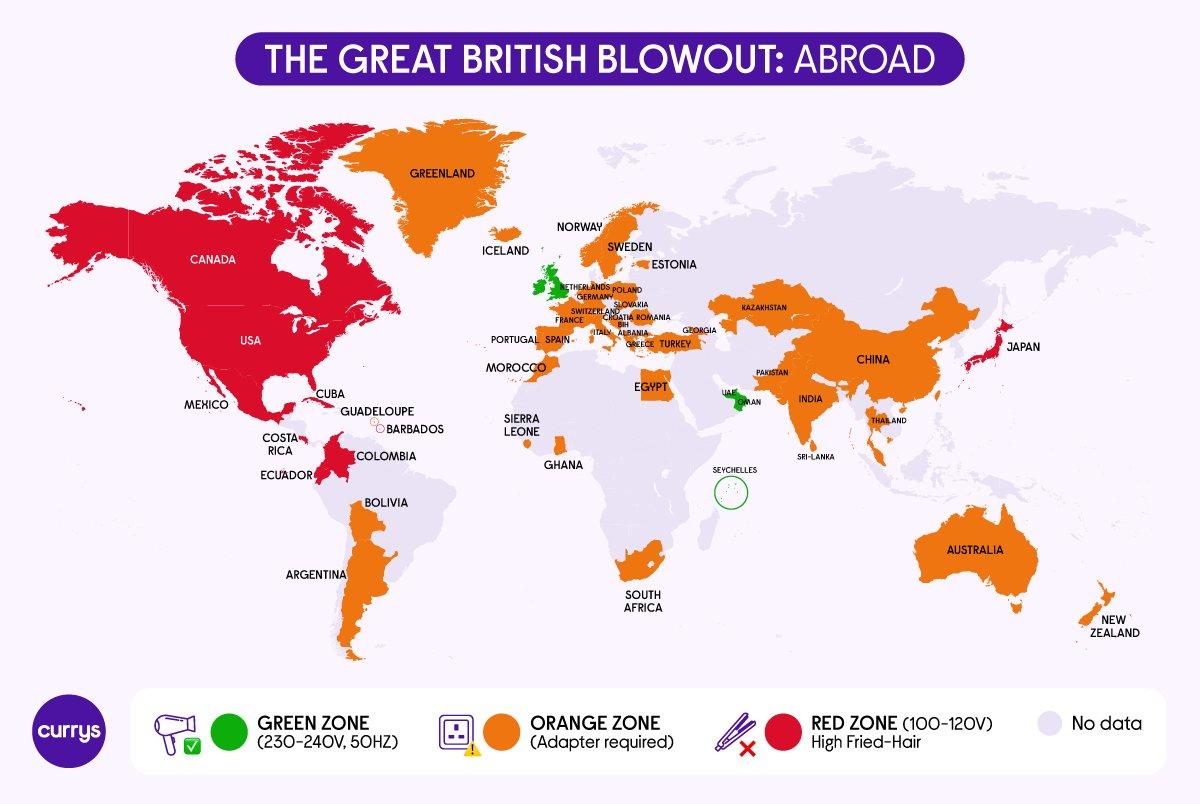
We’ve rounded up the destinations where UK travellers are most likely to encounter a major power struggle. Unlike the UK's standard 230V system, these countries operate on much lower 100–127V power supplies.
The good news? You can leave the tech anxiety behind for your primary gadgets, as most modern smartphones, laptops, and USB chargers are dual-voltage by design and will work perfectly fine with just a standard plug adapter.
However, if you plug a single-voltage UK appliance like a high-wattage hair dryer, straightener, or electric toothbrush charger into one of these sockets, it simply won’t get enough juice to heat up or power your motor properly, leading to potential critical malfunctions. Here are the countries where you’ll need a voltage converter for these devices.

Countries Requiring a Voltage Converter for Single-Voltage Devices
If you are jetting off to any of the following destinations, packing a standard plug adapter isn't enough to run your favourite styling tools; you’ll need to pack a voltage converter, too.
For instance, North American favourites like the USA and Canada utilise Type A and B sockets running at a much lower 120V. Similarly, tropical getaways such as Barbados (115V), Costa Rica (120V), Colombia, and Cuba (both 110V) use these same flat-pin configurations. Even far-flung destinations like Japan drop down to a delicate 100V system, meaning your high-wattage styling tools won't just encounter a completely foreign wall socket, but a power line that lacks the muscle to heat them up safely.

Victoria Bennion, Head of Category says, “Taking a single-voltage UK appliance to a low-voltage country means it’ll only receive about half the power it’s built for and won’t heat up properly. When you force a high-wattage heating element to run at an undervoltage, you can permanently stress and damage the internal circuitry. Make sure to always check your device for the ‘100-240V’ label before you travel. If it only says ‘230V’, it’s time to get a voltage converter.”
Countries Where UK Electronics Are Generally Safe to Use
For the majority of standard holiday destinations, you can breathe a sigh of relief. These locations operate on a compatible 220–240V power supply, which perfectly matches the UK's electrical standards, so all you’ll need to pack is the correct plug adapter to bridge the gap between different wall sockets.

Compatible Countries That Still Need a Plug Adapter
While the electrical current flowing through the grid in these regions is identical to home, the physical walls you are plugging into are not and will require an adapter. For instance, European favourites such as Spain, Germany, Portugal, Greece, and Turkey predominantly use Types C and F sockets, with France using Types C and E. Meanwhile, Italy utilises its own Type L system, and further-flung getaways like Australia (Type I), Thailand (Types A, B, C, and O), India (Types C, D, and M), and Morocco (Types C and E) all feature distinct pin configurations.
When travelling to these destinations, your only hurdle is shape, not power. A standard travel adapter will do the trick, allowing your high-wattage appliances to function safely and efficiently just like they do in your own bathroom.
Bennion explains, “It's a common misconception that a plug adapter changes the electricity. In reality, it simply plays matchmaker between your British three-pin plug and a foreign wall socket. For destinations that share our 220-240V standard, your tools are perfectly safe. Just ensure your adapter is firmly seated in the wall, as loose connections can cause devices like hair dryers to spark or overheat the adapter itself."
Compatible Countries Where No Adapter Is Needed
At the absolute peak of travel convenience are the rare destinations where you can leave all the extra gear at home. Only a select handful of locations allow UK travellers to unpack their bags and plug their appliances directly into the wall completely unassisted.
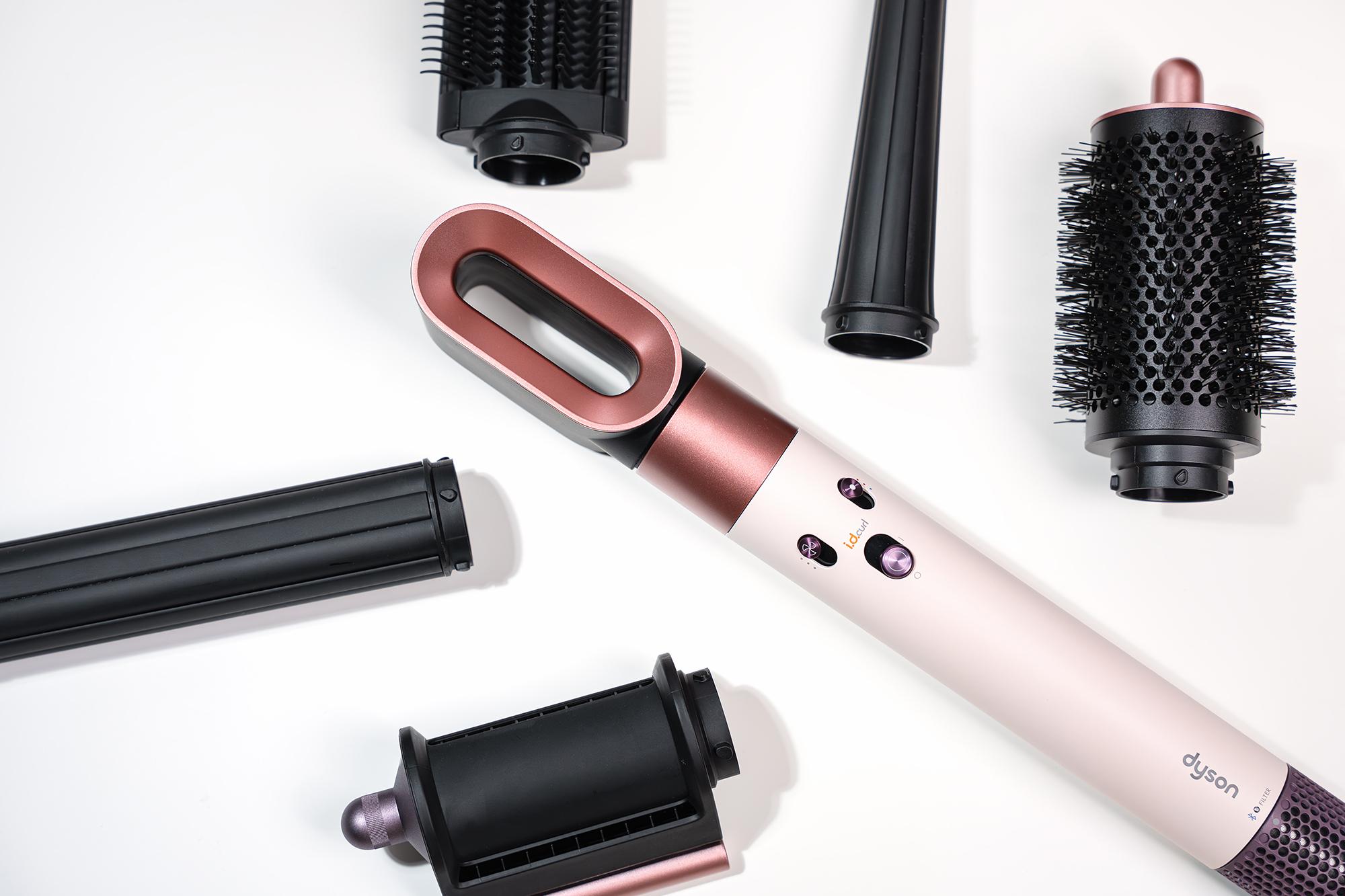
Holiday spots such as the UAE, Oman, and the Seychelles utilise Type G sockets, which are the same rectangular three-pin system we use in the UK. Because this hardware is paired with a matching 220–240V supply, these countries represent the ultimate ‘Safe Zones’ for your tech, offering a seamless plug-and-play experience for everything from your smartphone to your Dyson Airwrap.
Expert comment:
“To be completely sure before you pack, just flip your device over, “ says Bennion. “If the input label reads 230V or 240V, you are officially cleared for a hassle-free blow out.”
Understanding Voltage Compatibility for UK Devices
Before you pack your bags and head to the airport, it pays to know exactly how your tech handles power abroad. Standard UK electrical devices are built specifically to thrive on a 230V, 50Hz power supply delivered through our classic Type G three-pin plugs. But, as we now know, global power grids are anything but uniform. Let’s find out which tools and tech you can use abroad with a standard adapter, as well as when lower-voltage destinations might require a voltage converter.
Which UK Devices Are Dual Voltage?
Most modern personal electronics are built with dual-voltage capabilities, meaning they are engineered to automatically recognise and adapt to different power streams worldwide (typically ranging from 100V to 240V). For these smart devices, you do not need to worry about a voltage drop ruining your trip - all you need is a standard plug adapter to match the local wall socket shape.
Devices that are usually dual-voltage include:
● Mobile phone chargers
● Laptop chargers
● Tablets
● Camera chargers
● USB charging devices
Bennion advises, “Don’t skip checking the voltage of your device before it goes in the case. A quick look at the label before you travel ensures you don't fry your device and end up with beauty burnout.”
Which UK Devices Are Single Voltage?
Many high-powered, heat-generating appliances are strictly engineered to run only on the UK’s standard higher voltage. Force these single-voltage tools to run on a lower-voltage grid, and they simply will not get hot enough to work properly. In the case of toothbrush chargers, Don’t put yourself at risk and check before you pack!
Common single-voltage devices:
● Hair dryers
● Hair straighteners
● Curling wands
● Electric kettles
● Some electric toothbrush chargers like Oral-B
Bennion points out, “Unlike your phone, high-powered single-voltage tools can’t adapt on their own. To use them safely and effectively in lower-voltage countries, a standard adapter won't cut it - you’ll need a proper voltage converter to ensure they work as intended.”
Travelling to Countries with Lower Voltages
If you are packing for destinations like the USA, Canada, Mexico, or Japan, your hair tools are about to hit a major power drop. These regions, along with tropical getaways like Barbados, Costa Rica, Colombia, Cuba, and Ecuador, run on much weaker electrical systems measuring between 100V and 127V.
“If you’re travelling to these destinations, both an adapter and a voltage converter are a must-have,” NAME notes. “While a basic adapter gets you into the wall socket, only a voltage converter gives your single-voltage UK hair and beauty tools the actual power they need to turn on and perform.”
Ready to Power Up for Your Next Getaway?
Whether you are heading to a plug-and-play 'Safe Zone' or a lower-voltage location, packing the right gear means you never have to choose between a fried styler or a flat holiday look. To keep your morning routine effortless and completely stress-free wherever you land, check out our full range of international travel adapters and explore beauty tools built to keep you glowing across the globe.